Monday, October 21, 2019

Choosing Footwear for Training

By Emil Chang and Daniel Jauregui

The key considerations for choosing training footwear are the tasks you’re trying to accomplish and the mechanics of your feet. We can divide most training shoes into two general categories based on the activities they’re best suited to: lifting and running.

Lifting Footwear
In strength training, we’re looking for the most stability possible. There’s a reason we squat heavy on very solid ground and not on yoga balls; this logic should carry over to your shoes. For lifting, the most optimal shoe will be one that doesn’t compress and that gives your feet a solid connection to the floor. This leads to two main options for strength training: minimalist shoes and weightlifting shoes.

Minimalist shoes provide the minimum amount of support possible so that you can press through the ground effectively. Additionally, they are relatively flat and have larger toe boxes. Having a flat sole allows your feet to maintain its arches while the toe box gives your toes more ability to spread. Generally, these are good shoes for individuals who spend most of their training time lifting, but also for anyone looking to improve the function of their feet and connection to the floor.

Below are a few minimalist shoe options that you may want to look into if you’re still lifting in very squishy shoes.

Minimalist Shoes:
  • Newbalance Minimus
  • Reebok Nano
  • Nike Metcon
  • Lems
  • Merell
  • Nobull (I don’t know what part of this should be capitalized because it’s a dumb name)

Note the first time you wear a more minimal shoe, you may find that your feet are sore for the first few days. This is a common effect and is a result of the musculature of your foot finally being used to stabilize your arches instead of just collapsing into some cushiony support. So... when changing shoes, be cautious. To lessen the likelihood of injury, wear them for short periods of time, over time. It may take anywhere from weeks to months to acclimate to the new shoes depending on the strength of your foot and type of shoe previously worn.

The other subcategory of shoes for strength training is actual weightlifting shoes. These are specialist shoes designed specifically to optimize your leverages in squatting and the olympic lifts (snatch and clean). They do so by providing a sole that is virtually non-compressible and an elevated heel. If you’re looking to get more serious about lifting, they may be something to look into, but they are by no means a necessity for the average training population. If you do ever decide to use them, understand that these shoes aren’t for walking around in or doing bicep curls; they serve a very specific purpose: maximizing your force output. With that said, these shoes are an excellent option for anyone hoping to improve their squatting mechanics/strength.


Running Footwear:
There is a slight controversy in the running world regarding running shoes. Should you wear thin, minimalist shoes without much cushion and zero heel drop (height difference between the heel and toe) or traditional running shoes with plenty of cushion? The answer is it depends, which is unsatisfying yet true. 
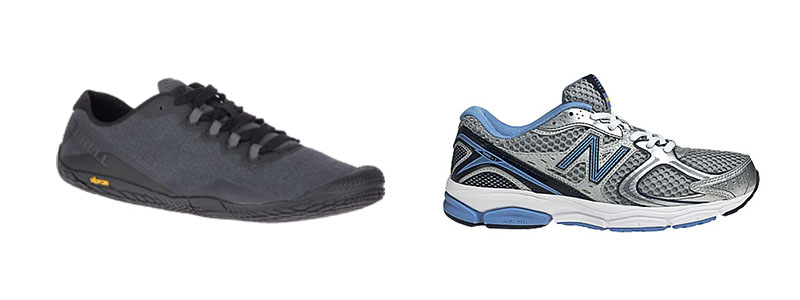


The first option, minimalist shoes, can work very well for running when good mechanics are utilized. A detailed discussion of mechanics leaves the scope of the post, but when using minimalist shoes you essentially want your foot to strike towards the ball of the foot and underneath your center of gravity. This allows the natural spring-like shock absorption system that your lower body possesses to take effect.

The more common running pattern people gravitate towards is a heel strike with the foot reaching out in front of the body. This method puts a tremendous amount of strain on your joints and musculature as there is little to no shock absorption happening each time the foot hits the floor. Instead, this is where a second shoe option comes into play.

Traditional running shoes
allow relatively injury-free running and can accommodate various biomechanical restrictions thanks to the significant degree of support they provide. They possess cushioned soles that absorb impact and can be beneficial for runners with a strong heel strike. However, the high heel drop perpetuates this heel-strike and the cushion limits full foot engagement.


The shoe you select ultimately depends on your own mechanics and feet. If you’re currently a traditional shoe-wearer and want to transition to minimalist, consider easing into it and allowing yourself time to acclimate to the reduced support. And don’t do it if you aren’t simultaneously trying to improve your running technique. Running with a pronounced heel strike in minimalist shoes can and likely will lead to chronic lower extremity issues. 

It’s important to note that shoe selection for various tasks is significant, but spending time outside of those shoes is equally important. Becoming dependent on shoes that you feel comfortable with is easy. However, spending more time barefoot can help your foot maintain much of its strength and form and can prevent the development of many issues.

Check out this playlist for some foot strengthening exercises.


Shoe Preferences from some of your Fitwell Trainers:

Elisa Terry (Expert Witness) - “As you can see, I wear Newbalance Minimus.”

Liz Au (Personal Training Coordinator) - “For running I like Brooks. For anything else, Chucks. I like to swim barefoot.”

KC Reischerl (Former Broadway Actor) - “I use Nanos for lifting, and Asics for Cardio. I have wide feet and am on my feet all day so I spare no expense.”

Vikram Prathap (Trainer) - “I wear Nobulls. Or something flat. I can ball in anything.”

Cindy Engle (Trainer) - “My favorite shoe for working out is the Reebok Nano 2.0. It’s light, flat, and a little wide. I feel supported during Olympic Lifts, can perform plyometrics in them, and at the same time I can run short distances and feel good.”

Rob Sanchez (Trainer) - “For sprinting I warm up with no shoes then switch to Vibrams. For lifting, I use flat shoes like Metcons or even go barefoot.”

Justin Lui (Trainer) - “For weightlifting I use Vans or Converse. Especially for deadlifting. I like a flat shoe but I can squat in anything cause I’m pretty mobile. I don’t do cardio.”

Em Chang (Filmmaker) - “I’ve worn Crossfit Nanos for the last six years. They’re good for lifting and if I ever happen to do short running, they’re fine for that. Plus they look okay.”

Tuesday, September 24, 2019

Three Tips for the Back Squat

This week we decided to focus on the back squat and three things everyone could do better . In my opinion, this is the most important exercise we do in BHIP so try to make sure you're doing these things. If you're not sure, ask an instructor. Enjoy!


Thursday, September 12, 2019

Mobility Series: Myofascial Release

Mobility Work
Spending time trying to improve your mobility is one of the least glamorous things the exercise world has to offer. Unlike with strength training or intense conditioning, you don’t lift anything heavy or move fast; you just sort of end up rolling around on the ground for 10 minutes wondering why it hurts so much. Despite its unappealing nature, mobility work is perhaps the most underrated aspect of fitness that people need to spend time developing.

The term mobility in this context refers to your joints’ range of motion. Having enough mobility enables you to do things like squat to depth or fully reach overhead. Many of the people that struggle to perform these basic movement patterns are unironically the ones who are least interested in foam rolling and stretching. The tighter you are, the more painful trying to improve becomes.

Myofascial Release
This process generally hurts so much for most of you because you build up a lot of stiffness throughout the day. Most of this comes from being in one static position for up to 8 hours at a time while sitting at your desk. Sitting for this long creates tension around the hip flexors, glutes, hip external rotators, quads, lower back, upper back, anterior shoulder, neck, and head; all of which are vital regions for healthy joints and effective training.

This is where myofascial release comes in as a method for alleviating that tension. It involves using an object like a ball, foam roller, pencil, or anything else you can think of to break some of the tightness up. Muscle tissue in the human body is surrounded by a connective sheet known as fascia that wraps around muscle bellies like a large casing. Whenever a muscle shortens or stays in one position for a prolonged period of time, the fascia shortens with it and will eventually become wound up into tighter tissue that we often refer to as “knots.” Myofascial release, or foam rolling, literally massages these areas of tightness to help unwind the muscles and fascia.

Implementation
Eventually, myofascial release won’t hurt nearly as much as you remove a lot of the knots and adhesions that are ingrained in your muscle tissue. Below is a video from Fitwell Trainer Liz on how you can easily perform some self myofascial release in your office.


Guidelines for Foam Rolling:
  • Roll above or below joints and on muscle only. Never on bone.
  • Apply enough pressure to produce actual change.
  • Spend 1-2 minutes on the relevant body part(s).
  • Do it 1-2 times daily.
  • If painful areas are found, dedicate more focus to those spots.
In addition, here are some basic methods you can begin incorporating regularly. Don’t be afraid to pull a foam roller out at BHIP anytime you’d like. If you have a particular question on how to tackle a certain area or improve a position, post it in the comments below.


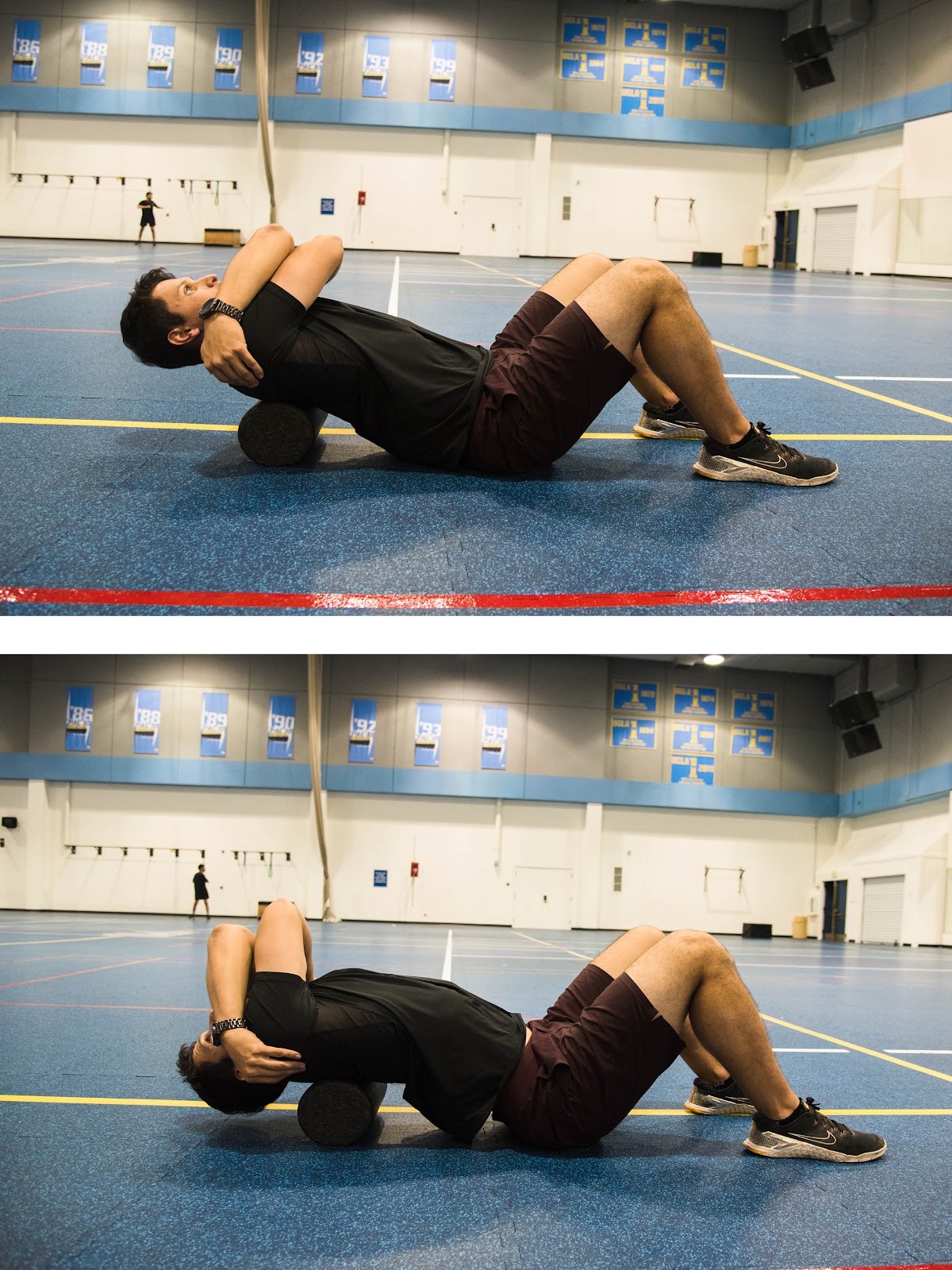
Thoracic Extension over foam roller (Left). Hamstring Release with Lacrosse Ball (Right).


Forearm/Hand Release with a pencil.

Monday, August 26, 2019

Three Tips on the Hang Power Clean


This week we have a video addressing some tips that can help your hang power clean. Based on what we see during classes, we've picked out three areas everyone can work on.


Monday, August 12, 2019

Working Through Weakness: The Hardest Part

By Emil Chang

In high school, I had a bad case of patellar tendonitis mostly due to pretending to be good at basketball when, in actuality, I was graceless and mediocre at best. In 2015, I had a superficial surgery on my chest that limited my range of motion for almost four months. Finally in 2018, I subluxed my left shoulder bouldering. Needless to say, I had substantial bouts of time when my training was limited because of injury.

If you're in BHIP, odds are you like exercising and being active. So the hardest part about a debilitating injury is perhaps not the pain, but the mentality. It's the disappointment of not being able to lift as much as you used to, or being unable to participate in the same conditioning as everyone else. It’s frustrating. You feel physically and mentally stagnant. Your body feels bleh. It affects parts of life outside of training as well. No doubt- it’s easy to fall into a dark hole of lethargic inactivity, longing for the past when you were at 100%, pain-free, and strong.

Animated GIF

That’s one way to think of it. However, as a coach and fellow injured person, I think injury and recovery should be part of your own path to success.

proud of you yes GIF by EditingAndLayout

 Quinn Henoch (in this video) and Josh Henkin (creator of Ulitmate Sandbag and spinal surgery survivor) have both talked about injury and recovery. Basically, recovery does not have to be a complete stoppage of activity. Sure, if you injure yourself deadlifting, it makes sense to stop deadlifting for a bit, but that's not the end of the story. The world of strength and conditioning is vast, and, if you wanted to keep moving, you probably could. Instead of recovery being passive, make it active. Use recovery as activity preparing your body to be as good as it can be to perform the next day.

Say you’re like me, and you had a problem in your left shoulder. Going overhead is not good and some pushing motion hurts. That sucks. But, you have another shoulder and two legs that work fine, as well as limited range of motion in your injured shoulder that is pain-free. So guess what? You can still exercise! All while not aggravating your bad shoulder!

 Same thing goes for any injury. Your knees are bothering you? Sure, avoiding knee-dominant exercises like squats and lunges is a good idea. But, you can still improve leg strength by hip hinging and maybe even deadlifting. This can also be an opportunity to work on your upper body strength. Struggling to get your first pull-up? Maybe this is chance to refocus your training towards that. 

Everyone's bodies are different. Your version of recovery will look different from everyone else's depending on your anatomy, overall strength level, and activity. My version of recovery is going to look different from a professional athlete's version, which is going to look different from a non-active adult's version, and so on.

Working through weakness is hard. It's probably harder than working out normally. But if you believe that you can still get stronger, faster, better, and keep working at it, then you've gotten past the hardest part.


 **If you ever need tips on how to restructure your training or modifications, feel free to ask your BHIP coach. Any other questions or relatable anecdotes? Comment below!

great job thumbs up GIF